
Markets in 2025: Resilience, Fundamentals, and the Power of Diversification
January 22, 2026
Markets entered 2025 amid no shortage of uncertainty. Trade disruptions tied to “Liberation Day,” geopolitical shocks, and persistent inflation concerns created a steady wall of worry throughout the year, yet financial markets proved remarkably resilient. Stocks and bonds both delivered strong returns as U.S. earnings accelerated, international equities outperformed from improving fundamentals and valuations, and fixed income re-established itself as a meaningful source of income and stability.
To understand where markets may be headed in 2026, we should first examine the key themes that shaped 2025 and brought us to today.
A Durable Economic Expansion
Despite frequent headlines warning of recession and geopolitical risk, the U.S. economy continued to expand at a pace that compares favorably with history.
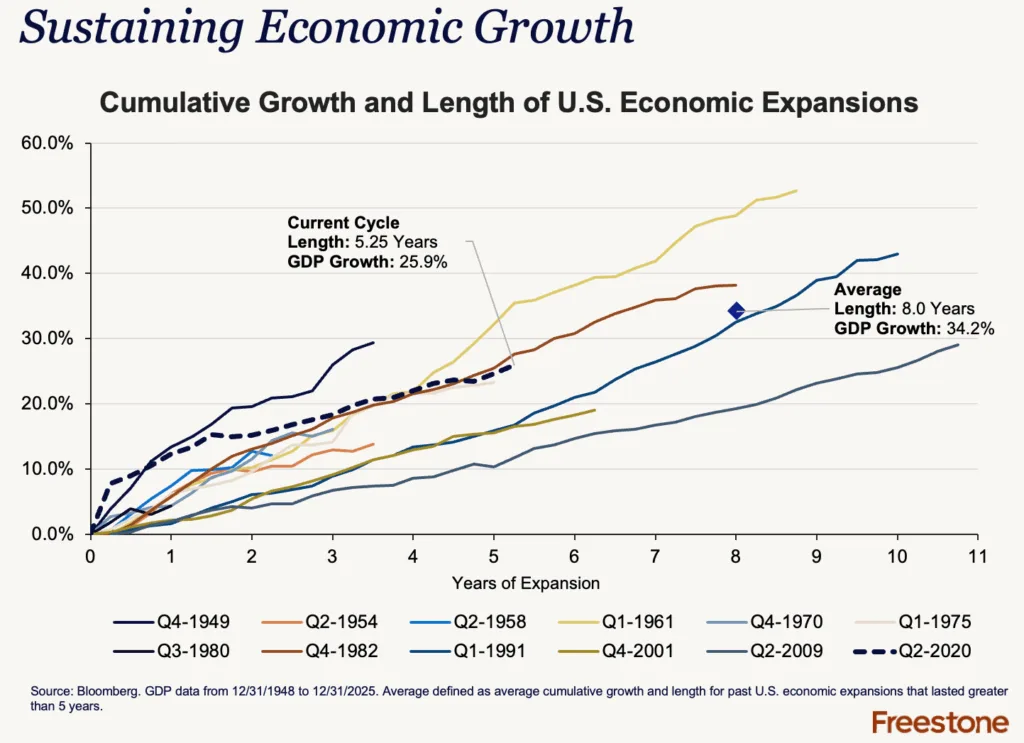
- Since 2020, the current U.S. economic expansion has generated more than 25% cumulative GDP growth, placing it among the stronger post-war cycles.
- Economic activity remained supported by resilient consumer spending, rising real wages, and elevated labor productivity, while inflation moderated closer to long-term norms.
- Why this matters: Markets ultimately follow earnings, and earnings follow economic activity. Entering 2026 with growth slowing, but not stalling, probably provides a constructive backdrop for diversified portfolios.
Artificial Intelligence: Opportunity with a Watchful Eye
AI remained a dominant market theme in 2025, fueling both enthusiasm and concerns about valuation excess.
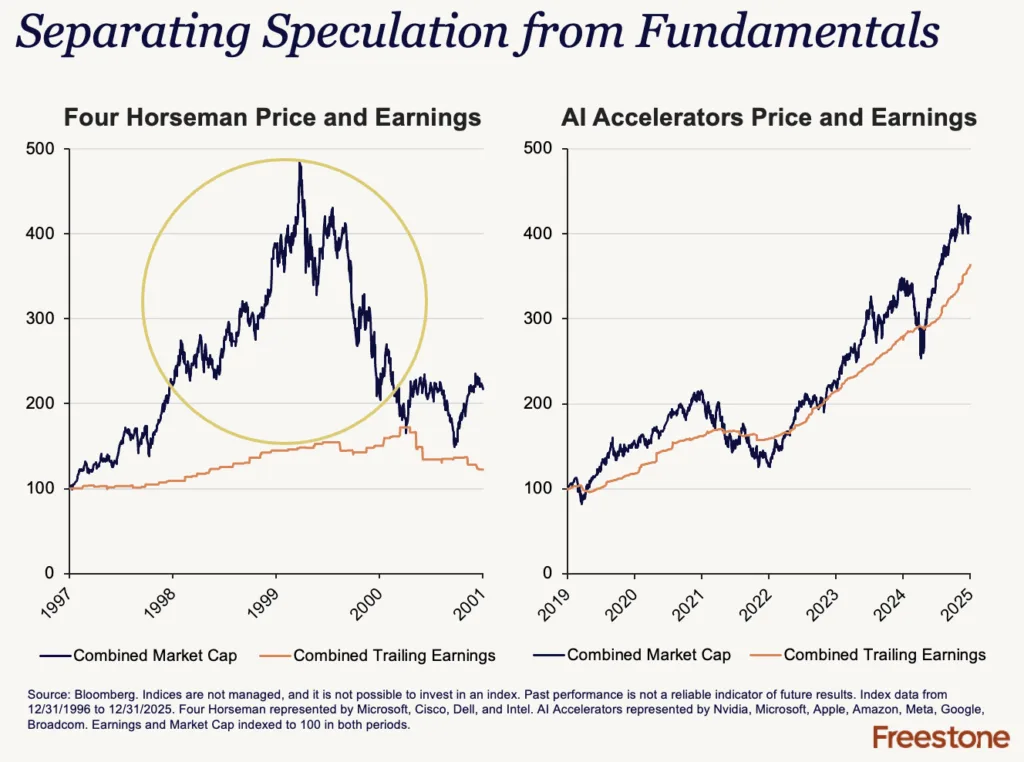
- A comparison with the late-1990s Dot-Com era highlights a critical difference: during the Dot-Com boom, stock prices surged far ahead of earnings, leaving little fundamental support when sentiment turned.
- Today’s AI leaders have seen earnings growth rise alongside market capitalization, indicating that fundamental support is helping drive performance. That said, the scale of AI-related capital spending continues to increase, and expectations remain high. As these investments mature, it will be important to see that revenue growth and profitability continue to justify valuations.
- Why this matters: The opportunity in AI is real, but price risk is not zero. Our focus remains on staying invested in companies where earnings support long-term value creation, while closely monitoring for any signs that prices begin to outpace fundamentals as we move through 2026.
Why Diversification Worked Again
One of the most important and under appreciated lessons of 2025 was the resurgence of diversification as a source of strength rather than compromise.
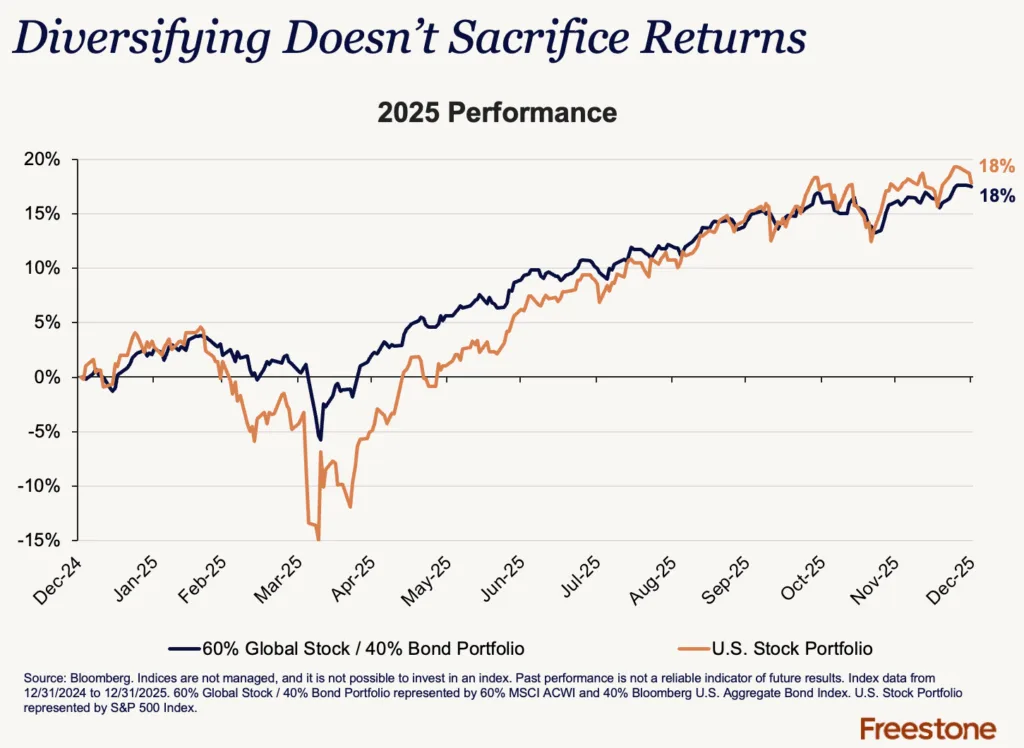
- A global 60% stock / 40% bond portfolio delivered returns comparable to a U.S. stock-only portfolio, while experiencing meaningfully smaller drawdowns during periods of market stress. Fixed income once again played its traditional role, supported by attractive yields, strong demand for corporate bonds, and Federal Reserve rate cuts in the second half of the year.
- Equity diversification proved equally valuable. While U.S. stocks posted solid gains, international equities outperformed by drawing on multiple return drivers, including earnings growth, rising valuations, higher dividends and buybacks, and currency tailwinds from a weaker U.S. dollar.
- Why this matters: When returns are attributed to many sources rather than one narrow theme, portfolios become more resilient. In 2025, diversification enhanced return efficiency while reducing risk, an increasingly important advantage as markets grow more complex.
Looking Ahead to 2026: More Levers, Greater Resilience
The lessons from 2025 are clear: The economic foundation remains sound, corporate earnings continue to do the heavy lifting, and diversification has once again proven its value. While the strength of the Magnificent Seven and AI leaders has raised understandable concerns, their performance has so far been mostly supported by earnings rather than excess. At the same time, leadership has broadened, and investors have been rewarded for looking beyond a single region, sector, or asset class.
As we move into 2026, our focus remains on building portfolios with multiple levers to pull, balancing exposure to high-quality U.S. innovators with compelling international opportunities, maintaining disciplined diversification, and preserving fixed income as both an income generator and stabilizer.
In an uncertain world, flexibility and balance remain two of the most powerful tools investors have.
Important Disclosures: For educational and discussion purposes only. Nothing herein is intended to provide, and it should not be relied upon for, accounting, legal, tax or investment advice or recommendations. We are not making any specific recommendations regarding any security or investment strategy, and you should not make any investing decisions based on the information herein. This document contains general information, opinions and market commentary and is only a summary of certain issues and events that we believe might be of interest generally. Opinions are subject to change without notice. While the information presented is believed to be reliable, no representation or warranty is made concerning the accuracy of any information provided, and we do not undertake any responsibility to update such information or advise you of any change in such information in the future. This document speaks only as of the date indicated. Indices referenced in this document are not managed and it is not possible to invest in an index. Past performance of any investment strategy is not a reliable indicator of future results. Links to third-party articles and/or websites are for general information purposes only, and not endorsed by us and you are encouraged to read and evaluate the privacy and security policies on the specific site you are entering.